Everyone Is Acting Normal at Work, and That Might Be the Weirdest Part
Christine R.May 11, 2026 6 min read
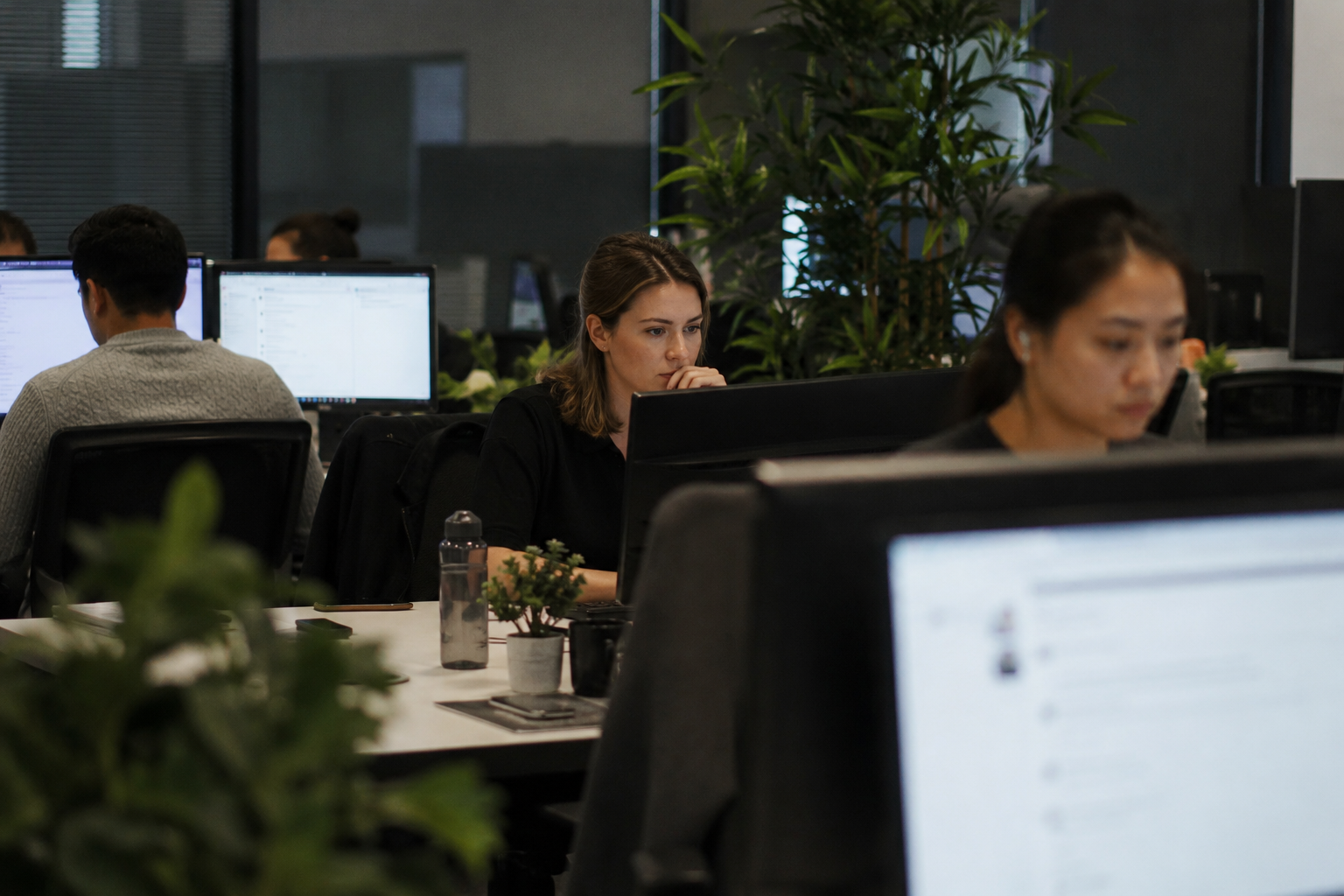
There is a very specific kind of silence inside work right now. Not the calm kind. Not the “everyone is focused” kind. More like the silence after someone says something strange in a meeting and everyone just keeps typing because nobody wants to be the person who reacts first. That is the mood. People are still joining standups, still writing “sounds good,” still adding thumbs-up reactions to Slack messages they have not emotionally agreed with, and still saying “quick question” before asking something that will ruin your whole afternoon.
Everything looks normal from the outside. The meetings still happen. The project boards still move around. The company updates still use words like “alignment,” “efficiency,” and “exciting changes ahead,” which, let’s be honest, usually means someone is about to have a terrible week. But underneath all of that polite corporate choreography, people know something is off. The old idea of work has cracked, and the strangest part is how calmly everyone is pretending it has not.
The old rule was simple enough to believe in. You joined a company, worked hard, learned the boring parts, got better, got promoted, and built some version of a life around the idea that being useful would protect you. Maybe it was never perfect. Maybe it was always a little fake. But it had structure. It gave people something to aim at. Now the structure feels less like a ladder and more like office furniture during an earthquake. Technically still there, but you are not fully trusting it.
A layoff here. A reorg there. A manager saying “AI transformation” with the same face people use when they are pretending a salad is enough for lunch. A company announcing record growth, then cutting a team the following week because apparently math has become more spiritual than financial. And everybody is expected to keep going. Update the roadmap. Smile in the all-hands. Pretend the phrase “strategic restructuring” does not sound like a polite warning label.
This is why so many people are no longer thinking in career ladders. They are thinking in rafts. A ladder assumes the structure is stable. A raft assumes the water might rise. And right now, the people building rafts do not look dramatic. They look awake. They are learning new tools, building side projects, keeping stronger networks, saving screenshots of results, documenting what they actually did, and making sure their value does not live entirely inside one company’s performance review system.
That shift is not laziness. It is pattern recognition. People watched companies spend years calling employees “family,” then saw the family turn into badge deactivation and severance paperwork when the budget got tight. People learned. They adjusted. A company can cut hundreds of people and call it “right-sizing,” but when a 27-year-old changes jobs for better pay, better growth, and fewer fake emergencies, suddenly everyone wants to have a moral conversation about loyalty. Please.
The loyalty conversation did not die because workers became selfish. It died because companies treated loyalty like a slogan instead of a contract. Workers noticed the gap between the posters and the practice. They noticed that “we care about our people” often has an expiration date. So now they are asking better questions. Will this job make me sharper? Will this manager actually teach me something? Will I leave with proof of what I built? Will this company still make sense in twelve months? Will I become more valuable here, or just more available?
That last question is the one nobody wants to sit with for too long. A lot of jobs do not make people better anymore. They just make people reachable. Reachable in Slack. Reachable after hours. Reachable during lunch. Reachable while pretending not to check email during a birthday dinner. We dressed it up as productivity, but some of it is just low-grade panic with notifications. People are not always building careers. Sometimes they are just surviving calendars.
And now AI has walked straight into the middle of this already exhausted system and made everyone ask an even uglier question: what part of me is actually valuable? Not busy. Not liked. Not included in meetings. Valuable. That is a brutal little word because it strips away the costume. It is sitting inside junior employees wondering whether AI is taking away the boring work they were supposed to learn from. It is sitting inside mid-level workers who feel too expensive to be safe and too busy to reinvent themselves. It is sitting inside managers who were hired to coordinate people and now have to explain why those people still need to exist.
Still, this is not only a doom story. The people who win this next era will not necessarily be the most obedient, the loudest online, or even the most technical. They will be the people with portable power. Skills that travel. Relationships that matter. Proof that speaks before they enter the room. A reputation that does not depend entirely on their current employer. A body of work. A point of view. A few people who will take their call when the market gets ugly.
That is the new career insurance. Not a fancy title. Not a company logo. Not a LinkedIn headline stuffed with five adjectives and one vague mission statement. Actual evidence. The ability to say: here is what I built, here is what I fixed, here is what I know, here is how I think, and here is why I am useful when things get messy. Because things are messy now. Pretending otherwise is just bad strategy with good lighting.
Maybe the career ladder was always a myth, or at least a story that worked better for the people already standing near the top. Most people were never climbing cleanly. They were balancing on layoffs, rent, burnout, bad managers, unclear expectations, and industries that change faster than performance review cycles. So maybe the new career model is not about climbing higher. Maybe it is about becoming harder to erase.
That is the real move now. Not panic. Not blind loyalty. Not fake hustle. Durability. The kind that says: I can move, I can learn, I can adapt, I can prove it, and if this place breaks, I will not break with it. That is not cynical. That is adult.
And maybe that is why work feels so strange right now. Everyone is acting normal because the old script still says we should. But the people paying attention know the script is outdated. The room has changed. The work has changed. The deal has changed. And quietly, very quietly, people are building their rafts
Be the first to like this article
Comments (0)
0/2000
No comments yet. Be the first to share your thoughts!
Share this article
Found this helpful? Spread the word.