Prediction Markets Are Starting to Look Like the Next Wall Street, and That Should Make Everyone Pay Attention
Christine R.May 25, 2026 11 min read
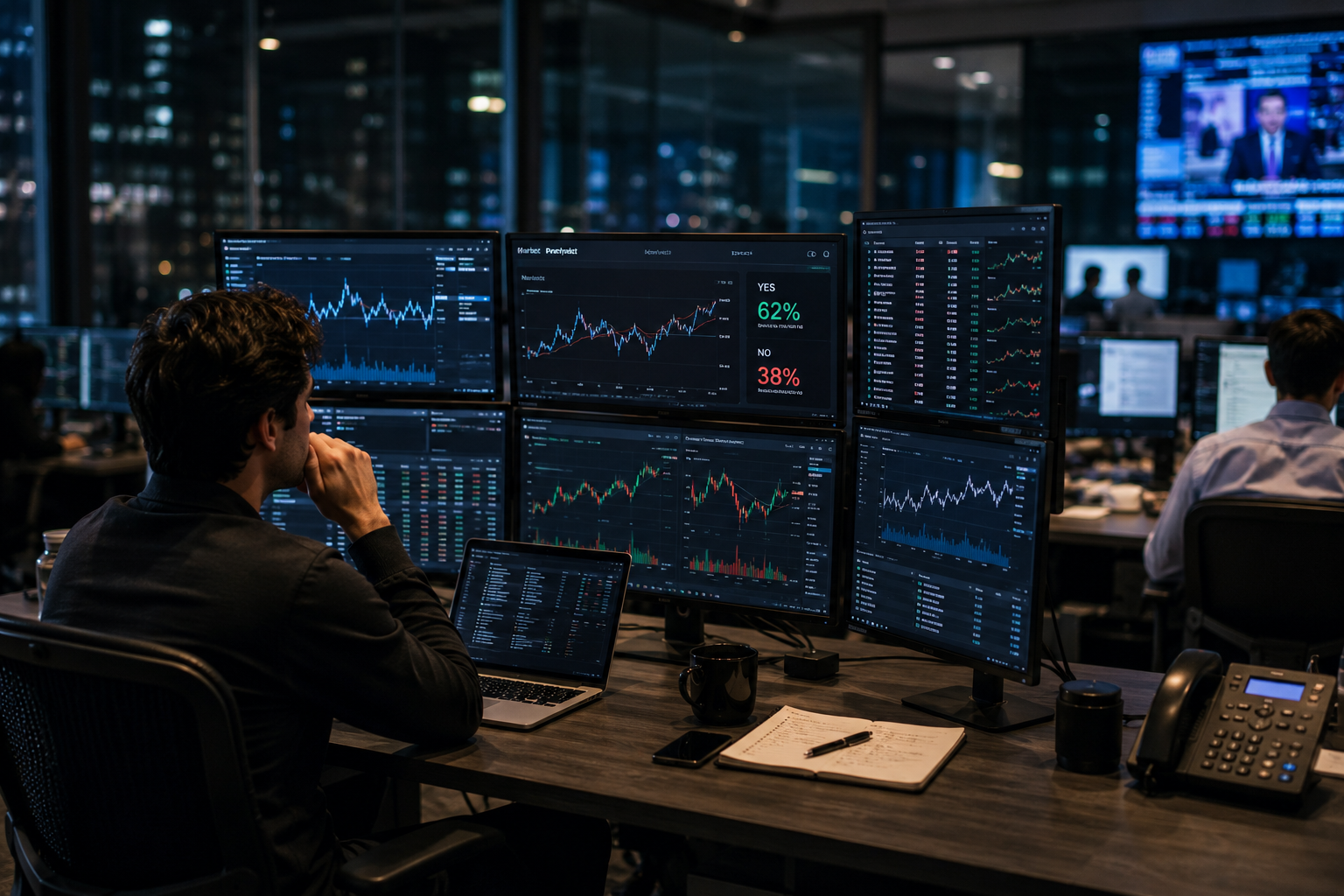
Prediction markets used to feel like a side quest on the internet. Not exactly finance, not exactly gambling, not exactly politics. More like a strange little room where overly caffeinated people argued about elections, interest rates, sports outcomes, court cases, and whether some billionaire would say something ridiculous before Friday. It was niche, a little nerdy, a little suspicious, and usually explained by someone on X with a chart, three monitors, and way too much confidence.
Then, almost suddenly, it stopped feeling small. Kalshi, Polymarket, Robinhood, sports leagues, regulators, crypto people, quant people, retail traders, AI researchers, and a growing crowd of very online market-watchers all started circling the same idea. The future itself might become something people trade every day. Not just stocks. Not just crypto. Not just sports bets. Actual outcomes. Events. Probabilities. Reality, sliced into contracts.
That is the strange power of prediction markets. They turn belief into a price. Not a poll. Not a pundit saying “sources close to the matter.” Not six people yelling over each other on cable news while pretending to understand voters in Ohio. A price. A number that says, in plain market language, this is what people with money at risk believe is likely to happen. That can be incredibly useful. It can also be incredibly dangerous, which is usually how you know a technology is about to matter.
A stock market prices companies. A prediction market prices events. Will the Fed cut rates? Will a candidate drop out? Will a team win the championship? Will a company launch a product before June? Will a CEO resign? Will a bill pass? Will a movie cross a billion dollars? Will it rain in New York next week? Some of it is serious, some of it is absurd, and some of it lives in that very modern zone where absurd things still move real money.
The bigger shift is that people are no longer just arguing about the future. They are taking positions on it. That changes the emotional temperature of everything. A prediction is no longer just an opinion you can casually walk back later. It becomes a trade. It becomes a receipt. It becomes a little public bet against uncertainty. And once the internet finds a way to turn belief, drama, politics, sports, finance, and ego into a live chart, you can almost hear the product managers sprinting.
The numbers are no longer cute either. Reuters reported that Kalshi said its annualized trading volumes had more than tripled over six months to $178 billion, while Polymarket’s monthly notional volume reached about $10.3 billion in April 2026 across its offshore exchange and U.S. platform. That is not basement hobby energy. That is infrastructure trying to be born. And infrastructure always attracts the same two things: money and rules.
The money part is obvious. Robinhood has moved into the space. Kalshi and Polymarket are fighting for cultural dominance. Media companies are watching because probability charts are addictive. Traders are watching because mispriced information is basically catnip. Founders are watching because anything with this much velocity eventually becomes a startup gold rush. Everyone can feel there is something here, even if nobody fully agrees on what to call it yet.
That naming problem is where the drama lives. Prediction markets sit in a strange legal and cultural space. They look like finance when they want legitimacy. They look like gambling when critics want them regulated. They look like forecasting when technologists explain them at conferences. They look like a dopamine machine when someone is clicking contracts at 1:14 a.m. with money they probably should not be touching. Annoyingly, all of those things can be true at the same time.
This is why the regulatory fight matters so much. Minnesota recently became the first U.S. state to ban prediction markets, and the CFTC quickly sued to block the law, arguing that these markets fall under federal derivatives regulation rather than state gambling rules. That is not some boring legal footnote. That is the battlefield. If prediction markets are treated like federally regulated derivatives, they get one kind of future. If states successfully frame them as gambling, they get another.
The platforms want to be Bloomberg Terminal for the future. Critics worry they are FanDuel with better typography. The truth is probably somewhere uncomfortable in the middle. There is real forecasting value here, and there is also real risk. The best version of prediction markets is not “let everyone bet on everything all the time.” That is not innovation. That is a slot machine wearing a Patagonia vest.
The best version is more serious. A live probability layer for the internet. A place where markets can show what people think before the official narrative catches up. A tool for pricing uncertainty in real time. A system that could make politics, finance, sports, climate, business events, and cultural moments more measurable. That is the dream. But dreams need plumbing, and plumbing means compliance, surveillance, market integrity, insider-trading rules, and all the boring stuff that keeps brilliant ideas from turning into scams with landing pages.
Sports leagues already understand where this is going. The NHL signed an information-sharing agreement with the CFTC to monitor prediction markets tied to professional hockey, including risks like insider trading, fraud, and match-fixing. Reuters noted that the agreement follows a similar CFTC arrangement with Major League Baseball. That is a very loud signal hiding inside a very boring sentence. Leagues know these markets are coming, and they know that if insiders, athletes, staffers, or connected people start trading on information nobody else has, the whole thing can get ugly fast.
Prediction markets have an insider problem by design. If the thing being traded is an event, then someone somewhere may know more about that event than everyone else. A politician knows campaign details. An athlete knows an injury. An employee knows a product launch delay. A lawyer knows a settlement is close. A founder knows an acquisition is dead. A regulator knows an announcement is coming. The future is not equally distributed. Some people always get tomorrow’s news early.
That is why trust becomes the product. Not the app. Not the chart. Not the cute contract names. Trust. Can the market be fair enough that the price actually means something? Can the platform catch suspicious trading before it poisons the market? Can regulators keep up without killing the category? Can users understand the difference between forecasting and gambling? Can these markets become useful without becoming predatory? That is the whole game.
Then AI enters the room, because apparently nothing in 2026 is allowed to remain purely human for more than five minutes. Researchers introduced “Prediction Arena,” a benchmark where AI models trade autonomously on live prediction markets using real capital on exchanges like Kalshi and Polymarket. The results were not some clean victory lap for AI. In fact, the paper found that models performed very differently depending on the platform, with live Kalshi returns ranging from losses of 16.0% to 30.8%, while Polymarket results were much closer to flat on average in one cohort.
That detail is wild, but not because the models crushed it. They did not. That is actually the interesting part. The important thing is that AI agents are now being tested not on static exams, not on cute reasoning puzzles, and not on benchmark questions they may have seen before, but in live markets where being wrong costs money. A model can sound brilliant in a chat window. A market is less impressed. The market asks a harsher question: fine, but would you buy it?
That is a different kind of intelligence test. Prediction markets may become a proving ground for whether AI can actually form useful beliefs about the real world under pressure. Not just summarize news. Not just write a persuasive paragraph. Not just explain both sides. Actually decide what is likely, take a position, manage risk, and face reality when the outcome resolves. That is much closer to the kind of intelligence business people actually care about.
There are already other research efforts trying to benchmark AI forecasting and trading on live prediction-market data. PolyBench, for example, evaluates large language models against Polymarket order books and real-time news streams, and its findings suggest a gap between fluent language and genuine probabilistic reasoning under market conditions. That is the part people keep underestimating. Sounding smart and being calibrated are not the same thing.
This is where prediction markets start to feel bigger than betting. They may become test environments for intelligence itself. Human intelligence. Crowd intelligence. Machine intelligence. The ability to say what is likely before it happens, then be scored by reality. That is a brutal scoreboard, and honestly, it might be one of the cleaner ones we have.
Maybe that is why this category feels so magnetic right now. It has everything. Money, drama, politics, sports, AI, regulation, addiction risk, founder ego, retail speculation, institutional ambition, and charts that make people feel smarter than they may actually be. It is finance, but faster. Media, but priced. Gambling, but dressed as derivatives. Forecasting, but with consequences.
No wonder tech people are circling it. No wonder quants are paying attention. No wonder regulators are nervous. No wonder everyone wants to own the rails. Because the winner here does not just get trading fees. The winner gets to become the place people check when they want to know what the world thinks will happen next. That is a powerful position. Maybe too powerful.
Imagine a world where every major event has a live probability attached to it before the headline lands. Elections, layoffs, IPOs, wars, mergers, executive exits, product launches, court decisions, sports injuries, central-bank moves. The future becomes a dashboard. That sounds useful. It also sounds exhausting. Because once everything has odds, uncertainty stops feeling mysterious and starts feeling tradable.
That changes behavior. People do not just watch events. They take positions. They root for outcomes. They chase edges. They search for leaks. They confuse being informed with being exposed. And when the future becomes something you can scroll, price, and trade, the emotional temperature of the internet goes up again. As if it needed help.
Still, I would not bet against this category. No pun intended, unfortunately. Prediction markets have the rare combination that usually makes new markets explode: simple user behavior, complex infrastructure, cultural obsession, regulatory tension, and a massive unresolved question. Are these markets gambling? Are they finance? Are they media? Are they intelligence infrastructure? The answer might be yes, and that is exactly why this race matters.
Kalshi and Polymarket are not just competing over who gets the most contracts. They are competing over who gets to define the category before regulators, incumbents, and users define it for them. Robinhood is not just adding another feature. It is bringing prediction markets to a mainstream trading audience that already understands the emotional loop of prices moving in real time. Sports leagues are not just signing memos. They are preparing for a world where every injury report, roster rumor, and game outcome can become a market-integrity issue.
AI researchers are not just playing with trading bots either. They are testing whether machines can form useful beliefs about reality under pressure. That might end up being one of the most important parts of this whole story. Because the next era of AI will not only be judged by whether a model can talk well. It will be judged by whether it can predict, decide, and act in environments where the feedback is real.
That is the real story. Prediction markets are becoming a battleground for who gets to price belief. And belief is not a small thing. Belief moves money. Belief moves elections. Belief moves markets. Belief moves people. For years, the internet was built around attention: who can get people to look? The next layer may be probability: who can tell people what is likely?
That is a different kind of power. We should probably pay attention before it becomes normal.
Because the future used to arrive as news.
Now it might arrive as a price.
Be the first to like this article
Comments (0)
0/2000
No comments yet. Be the first to share your thoughts!
Share this article
Found this helpful? Spread the word.